
 EN
EN
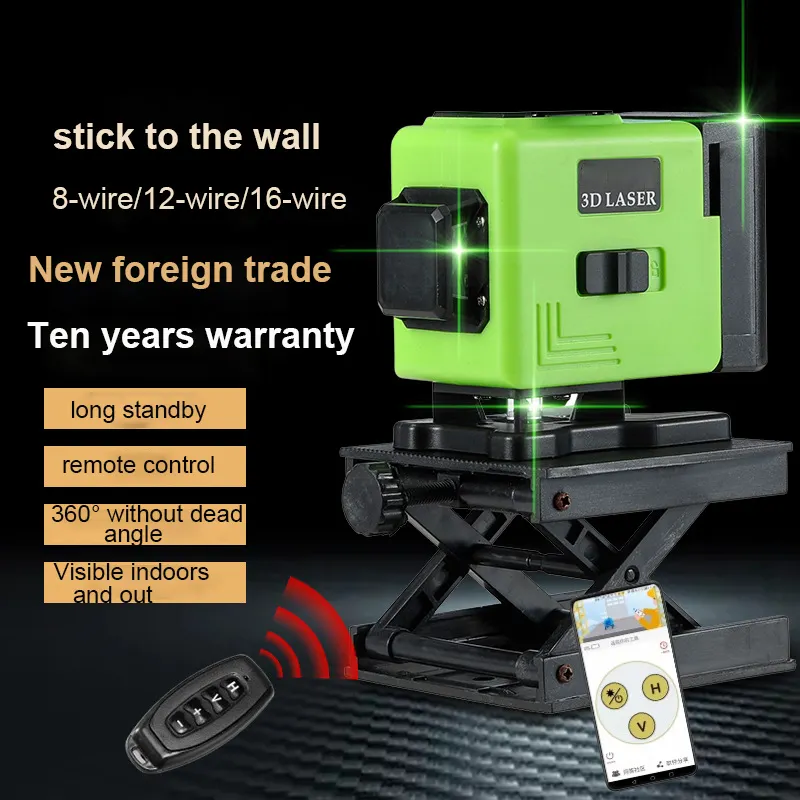
Rotary Laser Levels: The Most Reliable Laser Level for Long-Distance Alignment
Why rotary laser levels dominate outdoor and large-scale construction alignment
When it comes to getting things aligned properly outdoors or in industrial settings, rotary laser levels have become the go-to tool for most professionals. These devices spin around 360 degrees, creating that flat reference plane across an entire job site something regular lasers just can't match. Construction crews rely heavily on this feature for laying out foundations, grading land, and making sure structures are level from one end to another. What really makes these tools stand out is their built-in self leveling system which keeps readings accurate within about half a degree even if the ground isn't perfectly flat. No need to keep adjusting after moving positions, which saves time and frustration. According to field reports, teams working on large sites (think 200 feet plus) typically finish setting up grades 40% quicker than with older techniques. And let's not forget about durability those IP54 rated cases hold up against dirt, rain, and accidental bumps, so they stay functional even in tough conditions where equipment failures would bring everything to a halt.
Beam visibility, line stability, and accuracy at 300+ feet: Engineering behind extended range
Precision at long distances relies on three integrated engineering solutions:
- Beam intensity: High-output 635nm diodes deliver brighter, more detectable beams—visible up to 500 feet in daylight when used with compatible detectors
- Gyroscopic stability: Precision-machined bearings minimize drift, holding alignment within ±1/8" at 100 feet (±3/8" at 300 feet) despite wind or equipment vibration
- Rotational control: Adjustable RPM (600–1,200) lets users balance coverage width and close-range precision—higher speeds enhance visibility across open sites; lower speeds improve fine-tuning near structures
Thermal-compensated pendulums counteract metal expansion from temperature shifts, preserving calibration integrity. Dual-axis self-leveling systems demonstrate <0.001° angular deviation per 100 feet in field testing—proven reliable on mega-projects like highway corridors and utility-scale solar farms.
Laser Detectors: Critical Accessories That Extend Effective Range of Any Laser Level
How detectors overcome visual limitations—and why they’re non-negotiable for long-distance work
The human eye just can't pick out laser beams past about 100 feet during the day time. It's basically impossible without help because of physics limitations that make trying to align things from far away pretty much useless. That's where laser detectors come in handy. These devices actually detect the specific frequency of the laser beam and then let workers know through sound signals or flashing lights. With these tools, operators can work effectively well over 300 feet away even when there's bright sunlight, heavy fog, floating dust particles, or annoying glare messing with visibility. Imagine trying to grade trenches or level pads without such technology. The whole process becomes guesswork at best and mistakes happen all the time on construction sites.
Most modern detectors rely on those sensitive photodiodes set up for standard laser colors like 635nm red or 670nm near infrared. These little sensors can pinpoint locations within just a few millimeters even when the laser beam gets weaker over long distances because air particles scatter the light around. What makes these detectors so valuable isn't just their tech specs though. They work reliably in all kinds of weather conditions and eliminate problems caused by tired eyes looking at laser dots all day long. Anyone working on jobs longer than 200 feet really needs these devices in hand, not tucked away in a toolbox somewhere. Without proper detection equipment, small alignment issues creep in unnoticed until someone has to tear everything apart later for fixes that could have been avoided with better monitoring from the start.
Decoding Range & Accuracy Specs: What ‘±1/8” @ 100 ft’ Really Means at 300+ Feet
How accurate measurements get worse as distance increases becomes really important when working over long ranges. Take a spec like ±1/8 inch at 100 feet for example. That actually describes angular error rather than straight line deviation. And here's where things get tricky the possible error grows in proportion. So if we look at 300 feet instead of 100, our measurement could be off by as much as ±3/8 inch. This kind of geometric scaling makes all the difference in real world situations. For instance, a 0.375 inch difference would be way outside what's acceptable for putting up structural steel or digging trenches for utilities. Contractors need to know these numbers cold before starting any major project.
| Distance | Accuracy Rating | Potential Linear Error |
|---|---|---|
| 100 ft | ±1/8" | 0.125 inches |
| 300 ft | Same angular error | 0.375 inches |
Premium rotary models mitigate this through advanced stabilization—including dual-axis compensation, pulsed laser modulation, and thermal drift correction—maintaining ±1/4" accuracy at 300+ feet, per independent evaluations in the 2023 Construction Tool Performance Review. Always verify accuracy claims at your project’s maximum working distance—not just baseline specs.
Top Laser Level Models Engineered for Consistent Long-Distance Performance
Comparing field-proven rotary laser levels by range, durability, and detector compatibility
For mission-critical long-distance work, performance hinges on verified range, environmental resilience, and universal detector integration—not just headline numbers. Field-tested benchmarks show clear tradeoffs among tiers:
| Feature | High-Range Model A | Balanced Model B | Compact Model C |
|---|---|---|---|
| Max Range (w/detector) | 2,600 ft | 1,600 ft | 800 ft |
| Accuracy | ±1/16" @ 100 ft | ±1/8" @ 100 ft | ±1/4" @ 100 ft |
| IP Rating | IP67 | IP66 | IP54 |
| Detector Compatibility | Universal | Universal | Proprietary |
The best rotary lasers can reach distances of around 2,600 feet thanks to their dual-axis compensation systems and pulsed beam tech. These high-end models maintain an impressive ±1/16” accuracy every 100 feet, even when temperatures fluctuate during long jobs. Most professionals need universal detector compatibility because it lets them pick up signals well beyond what the naked eye can see, which becomes critical when working on sites larger than 1,000 feet. Mid-range equipment offers good value at about 1,600 feet with solid IP66 protection against dust and water, making them suitable for typical outdoor construction work. The smaller compact models tend to be limited though since they often come with proprietary detectors that don't play nice with other brands or leave room for future improvements. For serious industrial applications, look for units with 10 arc-second leveling precision that stops those annoying errors from building up over long stretches like football fields. Bonus points go to models with battery life stretching past 100 hours. And let's not forget about durability either these rugged cases have been tested to withstand drops from six feet onto concrete according to the latest findings from the Construction Tech Durability Report released last year.
FAQs
What makes rotary laser levels ideal for long-distance alignment?
Rotary laser levels provide a 360-degree reference plane, enabling precise alignment across large sites. Features like self-leveling systems and durable construction enhance their suitability for outdoor and industrial use.
How can laser detectors extend the range of laser levels?
Laser detectors detect specific laser frequencies and provide visual or auditory signals, allowing users to work effectively beyond the naked eye's range, making them essential for long-distance projects.
Why do accuracy specs change with distance?
Accuracy specifications, such as ±1/8” @ 100 ft, denote angular error. This error expands linearly with distance, meaning it can grow to ±3/8” at 300 ft, which is why understanding and adjusting for this is crucial in project planning.
Table of Contents
- Rotary Laser Levels: The Most Reliable Laser Level for Long-Distance Alignment
- Laser Detectors: Critical Accessories That Extend Effective Range of Any Laser Level
- Decoding Range & Accuracy Specs: What ‘±1/8” @ 100 ft’ Really Means at 300+ Feet
- Top Laser Level Models Engineered for Consistent Long-Distance Performance
- FAQs